 See What’s Possible for My Space
Share This Post
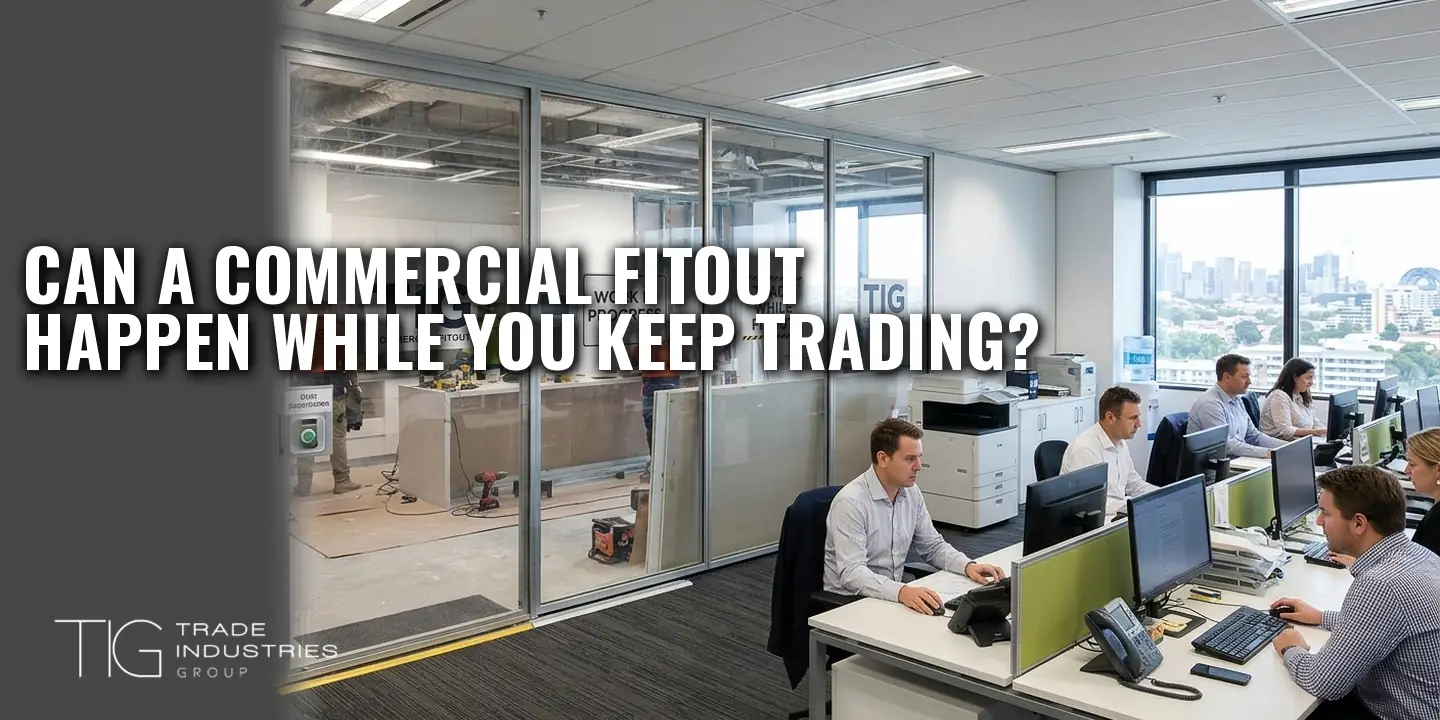
Commercial fitout while trading is possible for some Sydney businesses. With careful staging, good separation between the building work and the areas people still use, and a well-planned program, disruption can be reduced. Whether you can safely stay open depends on the scope of work, the building layout, access requirements and essential services such as power, water and fire protection. Some projects need a temporary closure or relocation during critical stages. The plan made before work starts matters, and so do the size and complexity of the job. Trade Industries Group (TIG), a Sydney renovation builder, can talk through whether a staged approach suits your premises.
Key Takeaways
- A commercial fitout while trading can work for some businesses, depending on the scope, layout, access and essential services.
- Offices and retail stores are often easier to stage, while kitchens and clinical rooms may need short closures.
- The NSW EPA recommends standard construction hours of 7:00 AM to 6:00 PM on weekdays and 8:00 AM to 1:00 PM on Saturdays. These are guidelines, so check your approval conditions and building rules for after-hours work.
- Fire exits, emergency lighting and fire protection systems must be managed throughout construction, and an affected area may need to close if safe occupancy cannot be maintained.
- Staged and after-hours work may increase building costs, but it can reduce lost trading. The best option depends on your project.
- Approval may be exempt, CDC or DA, depending on scope. Your council or a registered certifier can confirm the pathway.
What Does a Commercial Fitout While Trading Involve?
A commercial fitout while trading means the builder works around your daily operations instead of asking you to close. The site is divided into stages. Each stage is sealed, built and handed back before the next one starts.
Three things make this work. First, physical separation: hoarding, dust screens and a protected walkway for staff and customers. Second, a working-hours schedule: noisy tasks like demolition, drilling and cutting are planned for times that suit your operations and the site’s approved hours. Third, a clear start and finish date for each zone, so your team knows which area they can use each week.
This is different from a full closure, where the builder takes the entire space and you stop trading. Closure is often faster, depending on the scope. A staged approach can help protect your revenue and customer relationships, but it needs more planning and careful coordination.
Which Businesses Can Run a Commercial Fitout While Trading?
Many office, retail and professional businesses can run a commercial fitout while trading, provided the layout allows the space to be zoned. Offices are often the easiest, because staff can sometimes move between floors or areas. Retail stores can sometimes work in sections, such as one side of the shopfloor at a time.
Medical and healthcare premises need extra care. Infection control, patient privacy and air quality requirements apply, so whether a practice can stay open has to be assessed case by case. Food businesses face strict hygiene and contamination-control rules, which can make live work difficult. For both, a short closure of the affected area may be needed. Every site is different, so check what is realistic before you plan around staying open.
You can read more about TIG’s office renovation and shop fit out services.
How Does After-Hours Commercial Office Renovation Work in Sydney?
After-hours commercial office renovation means noisy and disruptive work happens at night or on weekends, so your team works in a quieter, cleaner space by day. In Sydney, this is common in office towers and shopping centres. The builder demolishes, drills and delivers materials after closing, then cleans and makes the area safe before staff return.
Construction working hours in Sydney depend on the project’s approval conditions, local council requirements and building management rules. The NSW Environment Protection Authority (EPA) Interim Construction Noise Guideline identifies recommended standard construction hours of 7:00 AM to 6:00 PM on weekdays and 8:00 AM to 1:00 PM on Saturdays, with Sundays and public holidays generally outside those recommended hours. However, these are guidelines rather than universal operating restrictions. Any proposed after-hours work should be checked against the applicable approvals and site requirements. Building managers and strata committees often add their own limits on lifts, loading docks and noise.
For a staged project, this timetable is set at the start. It also affects cost, which is covered below.
What Approvals and Safety Rules Apply to a Commercial Fitout While Trading?
A commercial fitout while trading needs the same approvals as any commercial fitout, plus a safety plan for the people still using the space. Approval depends on the scope. Minor internal work may be exempt. Larger alterations may need a complying development certificate (CDC) or a development application (DA) under the Environmental Planning and Assessment Act 1979 (NSW). The NSW Department of Planning, Housing and Infrastructure explains the pathways on its planning portal. Your council, or a suitably qualified planning or certification professional, can confirm which pathway applies to your premises.
A registered certifier, under the Building and Development Certifiers Act 2018 (NSW), checks that the work meets the National Construction Code. Fire exits, emergency lighting and fire protection systems must be appropriately managed throughout construction. Where essential safety systems need to be temporarily isolated or affected, suitable controls and alternative arrangements must be in place before work proceeds. If safe access and occupancy cannot be maintained, temporary closure of the affected area may be necessary. Walkways must stay clear and signed.
Safety law applies to both builder and business owner. The Work Health and Safety Act 2011 (NSW) requires everyone running a workplace to manage risks. SafeWork NSW sets out the rules on hazards like asbestos, which may need to be checked in older buildings before any demolition starts. A good builder will build the safety plan into the program before work begins, and you should ask to see it.
Does a Commercial Fitout While Trading Cost More Than Closing?
A commercial fitout while trading may increase construction costs because of staging, after-hours work and additional site protection. However, staying operational can help reduce lost revenue and business interruption. The most cost-effective approach depends on the construction scope, the program and the financial impact of temporarily closing. The comparison is building cost against business downtime, not building cost alone.
Staged and after-hours work can add cost in four ways: night and weekend labour, temporary screens and protection, extra cleaning each day, and a longer program. These are the cost drivers to ask about.
Closure can remove some of those costs but adds others. You may lose sales or billable hours, you may pay rent on an empty space, and customers may move to a competitor. For a business with steady daily income, those losses can be significant. For a business that can pause easily, closure may be the better choice.
TIG does not publish fixed fitout prices online, because every site is different. A consultation can compare the options for your premises and trading pattern.
Closure, After-Hours or Staged: Which Commercial Fitout Approach Suits You?
Staged work, after-hours work and closure each suit different situations. The table compares the three. These are general patterns, and the right answer depends on your site.
| Factor | Full closure | After-hours only | Staged (zoned) |
|---|---|---|---|
| Trading during works | None | Usually full, during opening hours | Partial to full, depending on staging |
| Build time | Often faster, depending on scope | Depends on permitted working hours and trade availability | Depends on sequencing and access |
| Building cost | May reduce staging costs | May be higher | Varies with the number of stages |
| Lost trading | Highest | May be lowest | May be reduced |
| Disruption to staff and customers | None, you are closed | May be lower, depending on noise and access | Managed by zones, varies by site |
| Often considered for | Small spaces, major services work | Sites with strict daytime noise limits | Larger offices and retail floors |
Many projects mix approaches. A common pattern is staged daytime work in quiet areas, with demolition and services work after hours.
Plan Your Commercial Fitout While Trading Around Your Opening Hours
The answer to “can a commercial fitout happen while my business keeps trading?” is sometimes yes, when it is planned that way from day one. Success depends on zoning, after-hours scheduling, approvals and a safety plan. It is a trade-off between build cost, program and lost income, and it needs to be assessed for each site.
Before you commit to any builder, ask these questions:
- Can customers and staff safely access the premises?
- Which areas will be unavailable during each construction stage?
- Will electricity, water, air conditioning or fire protection systems need temporary shutdowns?
- How will dust, noise and construction materials be controlled?
- What work can legally and practically be completed after hours?
- What is the contingency plan if a stage takes longer than expected?
If you are planning a substantial commercial fitout in Sydney, TIG can walk you through the options for your site. See our commercial renovation services for what we offer.
Talk Through Your Commercial Fitout While Trading
Keeping your business operating during construction takes careful planning, clear communication and a realistic program. Tell us about your premises, your operational needs and your trading hours. We will discuss whether a staged approach may suit your project, what approvals are likely and where the risks sit.
Request a Free Consultation. No pressure. No jargon. Just straight-up advice. Or call 0468 013 922.
Frequently Asked Questions
1. Can my business stay open during a commercial fitout in Sydney?
Sometimes. Many offices and retail stores can manage a commercial fitout while trading if the builder separates the work zone, schedules noisy tasks outside trading hours and manages exits and services safely. It depends on the scope, layout and safety needs. Kitchens and clinical rooms often need a short closure.
2. How do builders control dust and noise during a commercial fitout while trading?
Builders commonly use sealed partitions, floor protection and daily cleaning to control dust. Noisy work is often planned outside trading hours. The NSW EPA’s Interim Construction Noise Guideline recommends standard hours of 7:00 AM to 6:00 PM on weekdays and 8:00 AM to 1:00 PM on Saturdays, but these are guidelines, not universal rules.
3. Does after-hours commercial office renovation cost more?
Often, yes. After-hours work can involve night or weekend labour rates, longer programs and extra cleaning. Those costs may be offset by reduced lost trading, but this is not guaranteed. A builder can compare the options for your premises during a consultation.
4. Do I need council approval for a commercial fitout while trading?
It depends on the scope. Minor internal work may be exempt, while larger alterations may need a CDC or DA. Work outside standard construction hours may also need approval. Your council, a registered certifier or a qualified planning professional can confirm the right pathway.
5. How long does a staged commercial fitout take?
It can take longer than a full closure, because work is split into stages or limited to certain hours, though this depends on the scope. Size, staging, access and approvals all affect the program. Ask your builder for a program showing the handover date for each zone.
 Do Commercial Fitouts Need Council Approval in NSW?
 Commercial Lease Guide for Sydney Tenants
About the Author: Trade Industries Group