See What’s Possible for My Space
Share This Post
To compare allowances between quotes, put every prime cost item and provisional sum from each quote into one table and check three things: what the allowance covers, how much it is, and how the contract adjusts the price if the actual cost is higher or lower. Two quotes can show the same total and still differ once the allowances are tested against real selections. A low allowance is not automatically a saving, because the final cost depends on what you select and what the work turns out to need. For residential building work valued over $5,000 including GST, NSW law requires a written contract. Any prime cost items and provisional sums should be clearly recorded in the contract documents.
Key Takeaways
- An allowance is a placeholder amount, not a fixed price.
- Prime cost items usually cover the supply of products you select later. Provisional sums cover work that cannot be priced accurately yet.
- Two quotes with the same total can hold very different allowances.
- If the actual cost exceeds an allowance, the contract price may be adjusted in line with the contract. A separate variation may also be needed if your selection or the scope changes.
- Ask each allowance to state its item, amount, what it covers and whether GST and installation are included.
- Compare adjusted totals after testing allowances against real supplier prices.
- In NSW, residential building work valued over $5,000 including GST requires a written contract.
What Is an Allowance in a Builder’s Quote?
An allowance is a placeholder amount in a quote for something that has not been chosen or fully scoped yet. When you compare allowances between quotes, you are comparing each builder’s reasonable estimate, based on the information available when the contract is prepared, for costs nobody can confirm until you pick tiles, tapware or appliances, or until walls are opened up.
Allowances come in two types: prime cost items and provisional sums. Both are common in Australian building contracts, and both are estimates, not fixed prices. The problem is not that allowances exist. It is that two builders can set them at very different levels for the same room, which makes the totals look comparable when they are not.
What Is the Difference Between a Prime Cost Item and a Provisional Sum?
A prime cost item normally covers the supply of a product you select later, such as tiles, tapware, a vanity, a cooktop or light fittings. Installation may be priced elsewhere in the quote. A provisional sum covers work that cannot be priced accurately when the contract is prepared, such as rock excavation, hidden termite damage or asbestos removal. To compare allowances between quotes properly, you need to know which type each line is.
Prime cost items are largely within your control. If the allowance is low, you can choose a product that fits it or decide knowingly to spend more. Provisional sums are different, because the unknown sits in the structure of the house. This is why a quote with many provisional sums on a home built decades ago deserves a closer look than the same quote on a new build.
How Do I Compare Allowances Between Quotes, Step by Step?
Comparing allowances between quotes works best as a seven-step, line-by-line check, done before you sign anything. This is the home renovation quote comparison checklist we would give any Sydney homeowner, whether or not they are building with us.
- Build one table. List every allowance from each quote side by side: room, item, amount, and whether it is a prime cost item or a provisional sum.
- Check what the amount covers. For prime cost items, confirm whether the allowance covers supply only and where installation is priced. For provisional sums, confirm whether labour, materials, equipment, removal, GST and the builder’s applicable margin have been considered.
- Test the amount against reality. Take the allowance for tiles, tapware or appliances to a supplier and see what it buys. If a bathroom tap allowance only buys basic product, the final price may need to be adjusted once you choose.
- Ask how the price is adjusted. Find out how the contract handles costs above the allowance, including any margin added on top.
- Ask what happens if you come in under. Check how the contract calculates increases and decreases, including any margins, and whether unused amounts are credited back.
- Confirm the exclusions. Anything unclear should be identified and confirmed in writing as included, excluded or allowed for.
- Write down the answers. Verbal assurances are harder to verify, so record the agreed clarification in the contract documents.
Why Do Two Quotes for the Same Renovation Look So Different?
When you compare allowances between quotes, you will often find the totals differ for several reasons. Quotes can differ because of scope, specifications, methodology, supervision, labour, quality, overheads, exclusions and allowances. A builder who sets a realistic allowance shows a higher total today. A builder who sets a lower allowance shows a lower total, and the final price may then be adjusted once the real cost is known.
The same pattern appears in scope. A quote that lists “kitchen renovation” in one line leaves a lot undefined, and an undefined scope is where allowances can grow. Our full house renovations work is scoped and priced against clear inclusions for exactly this reason: if it is not written down, it cannot be fairly compared.
How Do Builder Allowance Adjustments Differ From Fixed Price Costs?
A fixed-price item covers defined work priced at signing. An allowance is a stand-in that is adjusted once the real cost is known. When you compare allowances between quotes, you are separating the part of each quote that is defined from the part that can move.
The practical test is simple: for every line, ask “if this costs more than shown, what does the contract say happens?” Fixed-price contracts can still change for agreed variations, allowance adjustments and other circumstances the contract allows. If the actual cost exceeds an allowance, the contract price may be adjusted in accordance with the contract. A separate variation may also be required if you change the selection, specification or agreed scope. NSW guidance describes a variation as a change or adjustment to what was agreed, and it should be documented and signed by both parties, except in urgent safety or property-damage situations.
| Feature | Fixed-price item | Prime cost item | Provisional sum |
|---|---|---|---|
| Pricing basis | Defined scope priced at signing | Allowance for supplying an item | Allowance for work not yet priced definitively |
| What may change | Price may change where the contract permits | Actual item cost and applicable adjustment | Actual cost of the work and applicable adjustment |
| What to check | Scope, inclusions, exclusions and contract clauses | Allowance, specification, supply basis and margin | Basis of estimate, scope, assumptions and margin |
How Do I Avoid Hidden Costs in Builder Quotes?
You avoid hidden costs in builder quotes by making every allowance specific, tested and written into the contract before you sign. The effort you put into comparing allowances between quotes only protects you if the chosen builder’s allowances then stay in the contract as agreed.
- Ask for each allowance to name the item, the room and the amount.
- Ask whether the amount covers supply only or includes installation, and whether it includes GST and delivery.
- Ask for an explanation of every provisional sum and how it was estimated.
- Make your selections before signing where you can, so prime cost items can be confirmed.
- Check the builder’s licence number is on the contract, then verify the licence status and class through the official Service NSW licence check.
- Ask about Home Building Compensation insurance. For covered residential work over $20,000 including GST, the certificate must be provided before the builder requests or accepts payment and before work begins. See the SIRA homeowner guidance on Home Building Compensation for details.
At TIG, our 6-step process includes Scope Clarification before pricing and contract sign-up, helping identify inclusions, exclusions and allowances before construction begins. Our builder’s licence number is 358098C.
What Should You Decide Before Signing?
Compare allowances between quotes on the same terms, then choose the builder whose quote leaves the fewest unanswered questions, not simply the one with the lowest total. A quote with realistic allowances, a defined scope and clear adjustment rules protects you better than a lower total built on low allowances. Before you sign, you should be able to say what is included, what could change, and how the contract handles it if it does.
Want Help Comparing Your Quotes?
If you want help to compare allowances between quotes and get a straight answer on what is included, we are happy to walk through it with you. No pressure. No jargon. Just straight-up advice on what is possible.
Request a Free Consultation or call us on 0468 013 922.
Frequently Asked Questions
1. What should I prepare before contacting a builder?
What you want to achieve, any existing plans or surveys, photos of the areas involved, your property address and whether it is heritage-listed or in a strata building, and the timeframe you have in mind. You do not need a finished design. A clear idea of your goals and priorities helps a builder tell you what is realistic.
2. Do I need plans before I speak to a builder?
Not always. Some homeowners bring completed drawings to price, and others start with a discovery conversation to decide between a separate designer and a design-and-construct team. If you have not yet chosen a designer, speaking to a builder early can help you understand how design decisions affect cost and approvals.
3. How do I check a builder’s licence in NSW?
Checking a builder’s licence is essential before signing a contract or paying a deposit. Ask for the builder’s legal name, licence number and ABN or ACN, then search the licence number on the Service NSW licence check. Confirm that the status is current, the licence class covers your type of work, any conditions are acceptable, and the name matches the contract entity exactly.
A licence check does not confirm insurance. Ask for the home building compensation certificate (where required) and other insurance certificates, and check those documents separately.
4. Do I need council approval for internal renovations in NSW?
It depends on the work and the property. Minor internal renovations in NSW such as painting or replacing floor coverings may need no planning approval, but minor work is not automatically exempt: the proposal must meet all applicable exempt-development requirements. Structural changes, such as removing load-bearing walls, generally need a DA or CDC. Heritage status can change the answer.
If you live in an apartment, strata approval is a separate requirement. Cosmetic work generally needs none, minor renovations follow an approval process, and major renovations need a special resolution of the owners corporation. Check council or planning approval and strata approval separately.
5. How are variations handled?
A variation is a written change to the agreed scope or price. It can be requested by you, or arise from unforeseen conditions or approval requirements. Ask how the builder prices and documents variations, and agree in writing before the extra work proceeds.
6. Is it better to knock down and rebuild or renovate?
The answer depends on the condition of the existing structure, your budget, the site, approvals and how much of the original home you want to keep. Choosing between a knock down and rebuild and a renovation is best tested with a site visit and a scoped assessment. A rebuild offers more layout freedom, while a renovation can keep character features and existing structure, but may reveal hidden conditions once walls are opened.
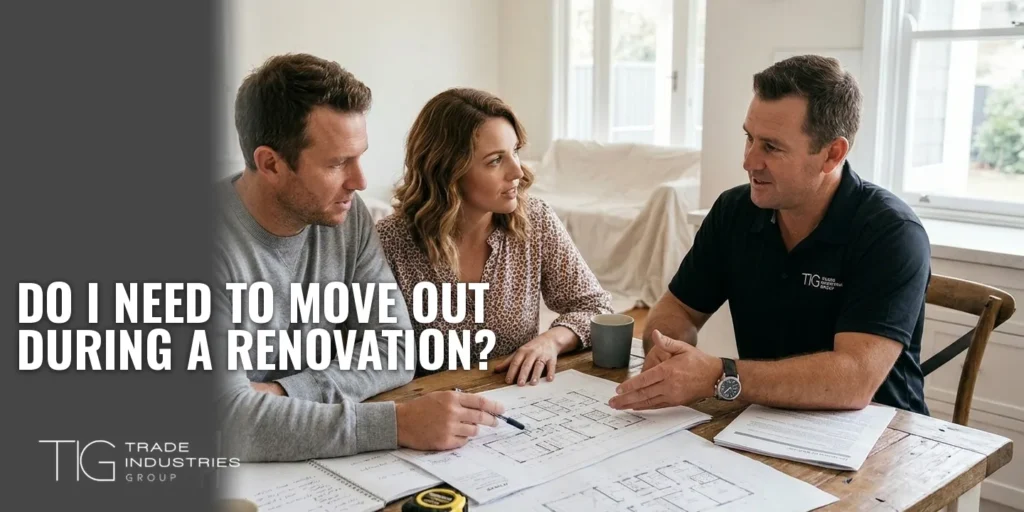
7. Do I need to move out during a renovation?
It depends on the scope, safety, access to services such as water, power and bathrooms, and how disruptive the work is for your household. Staging the work may be possible on some projects but not others. Discuss living arrangements with your builder early, before the contract is signed.
 Do I Need to Move Out During a Renovation?
About the Author: Trade Industries Group